The question I get most often about pump equipment is some version of “how long should I run it?” The standard answer that floats around is 8 to 10 hours a day. That is a reasonable starting point for an average pool in a moderate climate.
Las Vegas is not a moderate climate.
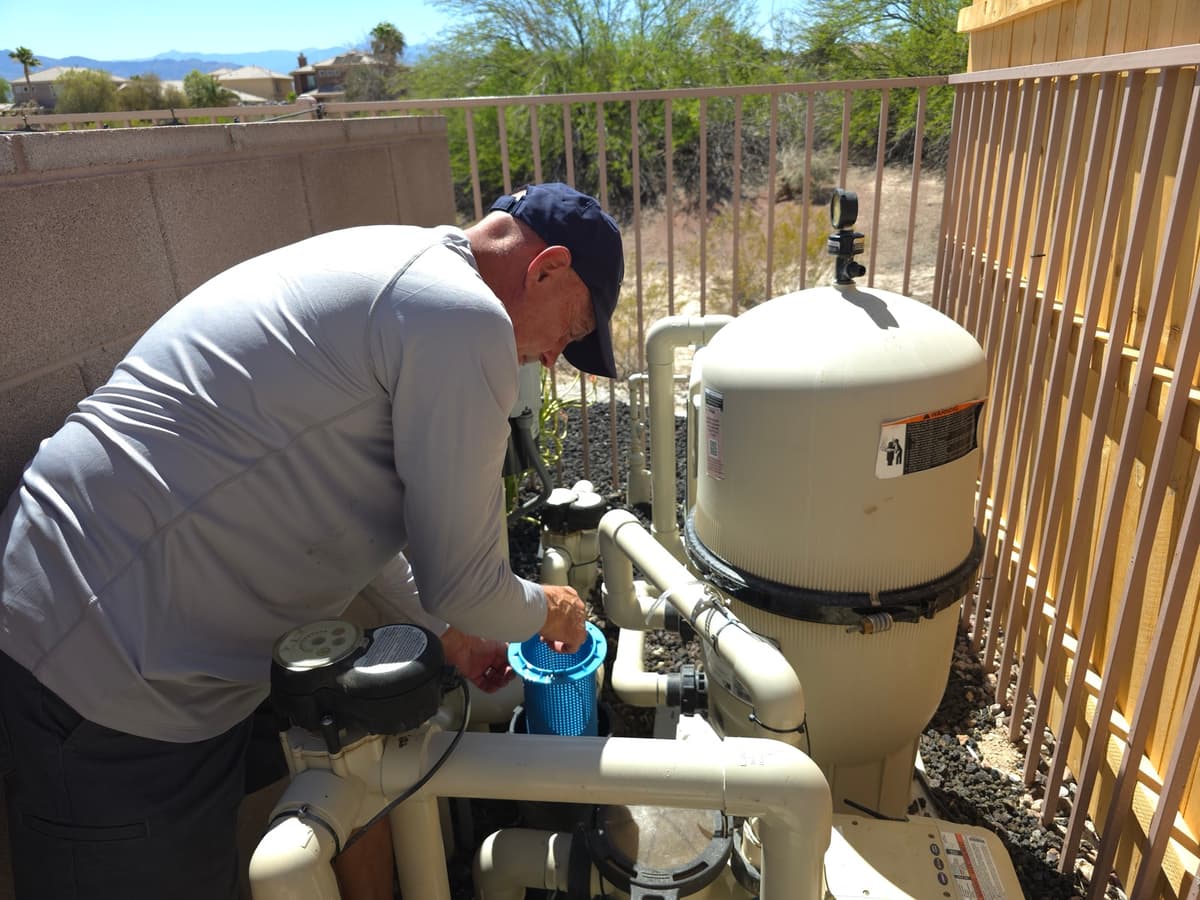
What “One Turnover” Actually Means
Every pump runtime guideline is built around the concept of a water turnover: the time it takes for all the water in your pool to pass through the filtration system at least once. One complete cycle through the pump, the filter, and back into the pool.
Turnover matters because your filter can only remove contaminants when water is actively moving through it. Chlorine and other sanitizers distribute evenly through circulation. Areas with poor flow, spots where the pump is not pulling strongly, become the first places algae takes hold.
The baseline for most pools is one full turnover per day. In Las Vegas, especially in summer, one is rarely enough.
Why Las Vegas Changes the Math
Three factors combine here in ways that general pool-care guidance does not account for.
Sun. The ultraviolet (UV) index in the Las Vegas Valley routinely hits 11 or 12 from June through August. Ultraviolet radiation degrades free chlorine faster than in almost any other climate in the country. More circulation keeps chemistry distributed and reduces the dead spots where sanitizer levels drop first. For how cyanuric acid protects chlorine from UV degradation, see the pool chemistry guide.
Wind. Las Vegas sees consistent strong winds, and that wind carries debris, dust, and organic material from the surrounding desert into every pool in its path. Each windstorm adds phosphates that feed algae and creates chlorine demand that the filter has to work against. For a full breakdown of what a Las Vegas windstorm does to pool chemistry, see What a Las Vegas Windstorm Does to Your Pool.
Location. Many of my clients live along the edge of a canyon or directly adjacent to undeveloped desert. That combination of open-land wind, airborne desert particulate, and full-sun exposure can put serious pressure on water chemistry within days of a service visit.
For pools in those conditions, I want to see 2 or 3 complete turnovers per day, not one.
How to Calculate Your Runtime
The formula is straightforward.
The Calculation
Pool Volume (gallons) ÷ Flow Rate (GPM) = Minutes Per Turnover
GPM = gallons per minute. Divide by 60 to convert to hours. Multiply by the number of turnovers you need.
Flow rate depends on the speed your pump is running. Variable speed pumps operate across a wide range of settings. The RPM (revolutions per minute) you choose determines how many gallons per minute move through the system.
Let me walk through the numbers using a 13,000 gallon pool as the example. That is close to the average size I see across my route here in the Las Vegas Valley.
At 1,900 RPM, the average flow rate is 30 to 50 gallons per minute. Using 40 GPM: 13,000 divided by 40 equals 325 minutes, or just under 5.5 hours for a single turnover. To get three complete turnovers at that speed, the pump would need to run over 16 hours.
At 3,450 RPM, the average flow rate is 65 to 100 gallons per minute. Using 85 GPM, the same pool reaches 3 turnovers in just over 7.5 hours.
Same pool. Same goal. But the pump speed determines whether the schedule is realistic.
13,000 Gallon Pool: Runtime by Pump Speed
| Pump Speed | Flow Rate | 1 Turnover | 2 Turnovers | 3 Turnovers |
|---|---|---|---|---|
| 1,900 RPM | 40 GPM | 5h 25m | 10h 50m | 16h 15m |
| 3,450 RPM | 85 GPM | 2h 33m | 5h 6m | 7h 39m |
Flow rates are approximations for a typical variable speed pump. Actual rates vary by pump model and plumbing configuration.
Reference: Common Las Vegas Pool Sizes
If your pool is a different size, here is the same calculation at high speed for the sizes I see most often on my route.
Runtime Reference at 3,450 RPM / 85 GPM
| Pool Size | 1 Turnover | 2 Turnovers | 3 Turnovers |
|---|---|---|---|
| 10,000 gallons | 1h 58m | 3h 55m | 5h 53m |
| 13,000 gallons | 2h 33m | 5h 6m | 7h 39m |
| 16,000 gallons | 3h 8m | 6h 17m | 9h 25m |
| 20,000 gallons | 3h 55m | 7h 51m | 11h 46m |
Calculations assume 85 GPM. Actual flow rate depends on your pump model, RPM setting, and plumbing.
What This Means for Your Schedule
Most modern variable speed pumps are designed to run for extended hours at lower speeds efficiently. A pump running at 1,900 RPM for 16 hours draws significantly less electricity than the same pump at max speed for a shorter window. The trade-off is pump hours, not necessarily operating cost.
That said, 16 hours at low speed is not practical for every pump or every timer setup. For pools with significant wind and desert exposure, running at a higher RPM setting for part of the day is worth considering.
The 10 to 12 hours I recommend for most Las Vegas pools assumes moderate conditions: a standard backyard with reasonable sun and wind exposure, a pump running somewhere in the mid-to-high speed range, chemistry maintained between visits. If your pool is regularly hazy, if your chlorine seems to disappear faster than it should, or if you have had recurring algae despite consistent treatment, pump runtime is one of the first things to look at.
For pools along the desert edge or near a canyon, start with your pool size and the three-turnover column. Then work backward to find the speed and schedule combination that gets you there.
The pool system guide covers how your pump, filter, and returns work together if you want a deeper look at the mechanics behind why circulation matters for water quality.