How Your Pool System Works
Las Vegas is one of the hardest environments a pool system can operate in. High heat, intense UV, alkaline and calcium-heavy tap water, dust, and rapid evaporation put real pressure on every component. Understanding what each part does and what it needs makes it easier to recognize when something is off and why consistent maintenance matters. The chemistry side of pool ownership, balancing pH, alkalinity, CYA, and chlorine in Las Vegas water, is covered in our pool chemistry guide.
How the System Works
Your pool runs as a continuous loop. Water is drawn in from the pool surface and bottom, cleaned mechanically through the filter, treated chemically, and returned. That process runs on a timer throughout the day, and every piece of equipment plays a specific role in keeping it moving.
The core path: pool water flows in through the skimmer and main drain, moves to the pump, passes through the filter, passes through or past the sanitizer delivery system, and returns through the jets.
When any part of that loop is compromised, everything downstream feels it. A dirty filter makes the pump work harder. A failing pump means water stops moving and chemistry changes rapidly. A clogged skimmer basket cuts down flow before it even reaches the pump. It all connects.
The Pump and Motor
The pump is the heart of the system. Everything else depends on it running reliably.
An impeller inside the pump housing creates the flow that pulls water from the pool and pushes it through the filter and back. The motor drives the impeller. Between the pump inlet and the impeller sits a strainer basket that traps debris before it can cause damage.
Pump basket: In Las Vegas, where wind-blown debris, dust, and palm fronds are a constant presence, pump baskets fill faster than they would in a lower-debris environment. A full or clogged basket restricts flow and makes the pump work harder than it should. Checking and clearing it is a first-line maintenance task.
Run time: During Las Vegas summers, most pools need 10 to 12 hours of circulation per day to maintain water quality. The combination of heat, intense UV, and debris load means the water needs to pass through the filter and sanitizer system more than it would in a cooler climate. For the full calculation by pool size and pump speed, see How Long Should Your Pool Pump Run in Las Vegas
Variable speed pumps: Variable speed pumps (VSPs) run at lower speeds for routine circulation and ramp up when more flow is needed for cleaning or chemical distribution. They use significantly less electricity than single-speed pumps, run quieter, and tend to last longer. Most new Las Vegas pool installations specify a VSP. Off-peak scheduling (running the pump overnight when electricity rates are lower) pairs well with a VSP.
Signs of trouble: Unusual noise from the pump housing, reduced flow from the return jets, the pump cycling on and off repeatedly, or a pump housing that is unusually hot can all indicate problems worth investigating promptly.
The Filter
The filter removes suspended particles from the water. Without it, even properly balanced water would turn cloudy within days from dust, sunscreen residue, fine debris, and organic material.
Three types of filters are common in Las Vegas pools. All three work, with different maintenance requirements.
Sand Filters
A sand filter forces water through a bed of filter media, which traps particles as they pass through. Sand filters are durable and straightforward to maintain. When the pressure gauge reads 8 to 10 psi above its clean baseline, you backwash: water runs backward through the media, flushing accumulated debris to waste.
Sand captures particles down to roughly 20 to 40 microns. Finer particles pass through. In Las Vegas, where caliche dust and fine airborne debris are a consistent presence, sand filters need more frequent backwashing than they would in a lower-dust market.
The media itself needs replacement every 5 to 7 years. As sand grains wear smooth over time, they lose the roughness that makes filtration effective.
Cartridge Filters
Cartridge filters use pleated polyester elements to trap particles, typically down to 10 to 15 microns. That is finer filtration than sand without backwashing. When pressure climbs, you remove the cartridge, rinse it with a hose, and reinstall.
As a rule of thumb, cartridges need cleaning every 3 to 4 months, though actual timing depends on your pool’s use, debris load, and the Las Vegas dust environment. Some pools need more frequent cleaning. The cartridge element itself should be replaced every 3 to 4 years as the material breaks down and loses its filtration efficiency, though environment and how consistently you clean it can shift that timeline in either direction.
A dirty or overloaded cartridge restricts circulation significantly. When a pool is harder to keep clear despite correct chemistry, a neglected filter is often the first thing to investigate.
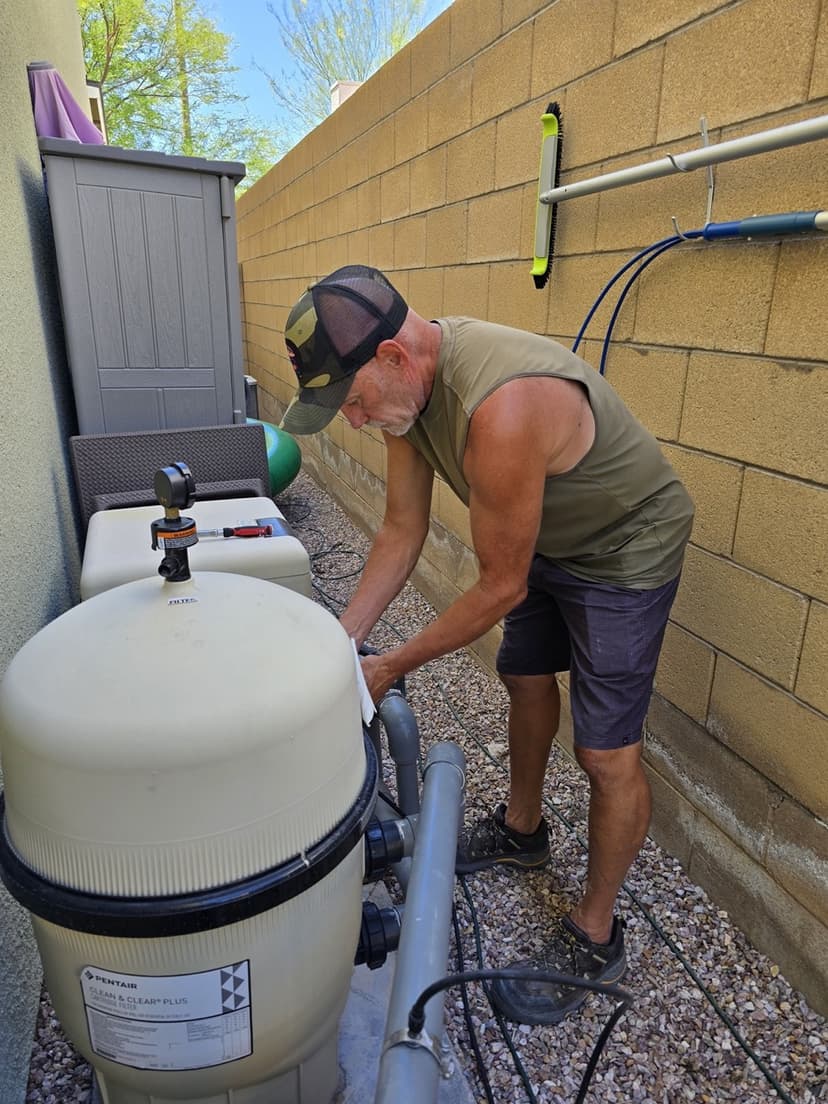
DE Filters
Diatomaceous earth (DE) filters coat internal grids with DE powder, which provides the finest filtration of the three types: down to 2 to 5 microns. The result is notably clearer water, particularly for pools with fine dust loads.
DE filters require more involved maintenance. They backwash, but not as cleanly as sand, and require fresh DE powder to be added after each backwash. The internal grids need periodic inspection and eventual replacement. DE powder requires careful handling and disposal.
For pools where water clarity is a priority and the owner or service provider is willing to manage the maintenance, DE filters perform well in Las Vegas conditions.
Filter cleaning is also a required step in any algae bloom recovery: the filter captures algae cells during treatment, and leaving it uncleaned reseeds the pool after every shock. See Why Pool Algae Keeps Coming Back in Las Vegas for why this matters.
Skimmers
Skimmers are the rectangular openings built into the pool wall at the waterline. They pull surface water into the circulation system before floating debris can sink to the bottom.
The weir (the floating flap at the skimmer opening) helps concentrate skimming action: it rises to let surface water in and drops to prevent debris from floating back out when the pump shuts off.
The basket: Inside each skimmer is a basket that catches leaves, insects, and other floating material before it reaches the pump. Keeping skimmer baskets clear is one of the most basic and important regular maintenance tasks.
In Las Vegas, skimmers work hard. Wind events can deposit significant debris overnight. During spring wind season or a dust storm, baskets can fill in hours. A full skimmer basket cuts down flow to the pump, which affects circulation throughout the entire system. For the full picture of what a Las Vegas windstorm does to pool water and chemistry, see What a Las Vegas Windstorm Does to Your Pool. For how to test accurately after a debris event, see Test Strips vs. Drop Tests: What Pool Techs Use.
Water level: The skimmer needs the pool water level to sit roughly halfway up the skimmer opening to function correctly. If the level drops too low, the skimmer starts pulling air instead of water, which can damage the pump. In Las Vegas summers, where evaporation can drop water levels noticeably between service visits, checking the water level and topping off as needed is an ongoing responsibility.
Return Jets
Return jets push filtered and treated water back into the pool. Most pools have two or more jets positioned to create circulation patterns that distribute chemicals evenly and prevent dead zones in corners and deep areas.
Pointing direction matters: Jets are typically angled to push water around the pool in a rotating pattern. In a well-circulated pool, chemicals reach every area more consistently, and debris gathers predictably rather than settling in unswept corners.
What reduced flow tells you: If the return jets feel noticeably weaker than usual, that is a useful signal. The most common causes are a clogged filter, a full pump basket, a low water level allowing air into the system, or a plumbing obstruction. Starting with the filter and basket before assuming a pump problem saves diagnostic time.
The Main Drain
The main drain sits at the deepest point of the pool floor. It works alongside the skimmer to provide suction to the pump and helps circulate water from the bottom of the pool, which otherwise tends to be cooler and less actively mixed.
Modern pools use dual main drains or antivortex covers for safety. In normal operation, the main drain is not draining the pool: it is simply a second suction point in the circulation loop.
Why bottom circulation matters in Las Vegas: Pool water can be noticeably cooler at the bottom during summer. Pulling that cooler water into active circulation helps distribute chemicals and temperature more evenly throughout the pool. A pool with poor bottom circulation can have adequate chemistry in the shallow end and deficiencies near the floor.
Sanitizer Delivery Systems
Clean water requires ongoing sanitation. The chemistry section of this guide covers the chemicals themselves. Here, the focus is on how sanitizer is delivered to the water.
Inline Chlorinators
An inline chlorinator (also called a chemical feeder) holds trichlor tablets and dissolves them slowly as water flows through. It provides a steady baseline chlorine dose between service visits.
Las Vegas note: Trichlor tablets contain cyanuric acid (CYA), which accumulates in the water over time and does not leave through evaporation. In Las Vegas, where CYA already needs to be managed carefully because of intense UV exposure, a tablet feeder requires consistent monitoring. If CYA climbs too high, chlorine becomes less effective even at normal reading levels. This is something a responsible pool service tracks as part of regular water testing.
Salt Chlorine Generators
A salt chlorine generator (SWG) converts dissolved salt into chlorine through electrolysis. The salt concentration in the pool is low and most people cannot taste it. The active component is the salt cell, a series of coated plates where the conversion takes place. A salt pool is still a chlorine pool: the equipment makes the chlorine instead of someone adding it by hand.
Las Vegas considerations: Hard water is the main challenge for salt systems here. Calcium scale builds up on the cell plates over time and reduces how much chlorine the cell can produce, so cells in Las Vegas need more frequent inspection and cleaning than they would in a softer-water market. Managing calcium hardness and keeping pH in range is what protects the cell.
For how salt systems work in detail, what changes about weekly care, and why tablets and salt cells work against each other, see the salt water pool guide.
Automatic Pool Cleaners
Automatic cleaners handle in-pool debris and vacuuming. They are useful tools, but they supplement filtration and chemistry: they do not replace them.
Suction-side cleaners connect to the skimmer line and run on pump suction. They are the most common and least expensive type. They move somewhat randomly through the pool and vacuum debris into the main filter system. Because they route everything through the filter, they can increase how often the filter needs cleaning.
Pressure-side cleaners use a dedicated booster pump and collect debris in their own bag rather than routing it to the pool filter. They move more predictably and do not add extra load to the main filtration system.
Robotic cleaners are self-contained units with their own motor and internal filter. They operate independently of the pool’s pump and collect debris in a bag you empty manually. A good robotic cleaner typically does the most thorough job, covers the pool floor, walls, and waterline, and does not add any load to the main pump or filter. They are the most expensive option but do not affect system wear.
In-floor cleaning systems are built into the pool structure rather than added to it. A set of heads sits flush in the floor and pops up in sequence, fed by a valve that directs water to one zone at a time. Nothing sits in the pool, and there is no unit to store, empty, or handle. The difference from the other three types is that the system does not travel to the debris: it sweeps debris across the floor toward the main drain, where it passes into the pump basket and filter the same way a suction-side cleaner’s load does. Coverage therefore depends on where the heads were placed and how much pressure reaches each zone. Because the heads sit in the floor rather than on the deck, servicing one is work done in the pool. For what these look like in practice on Las Vegas Valley pools, see Your Pool Looks Clean. Turn the Pump Off..
In Las Vegas, whatever cleaner type you have will encounter more fine dust and debris than it would in most markets. Cleaners operating in heavy dust conditions need their bags and filters emptied more frequently.
Heaters
Many Las Vegas pools operate without heaters because the climate keeps water warm from late spring through early fall naturally. For pools used year-round, or by people who want warmer water in the shoulder seasons, several heater types are available.
Gas heaters heat water quickly and work regardless of ambient air temperature. They are effective for on-demand heating but have higher operating costs during sustained use.
Heat pumps extract warmth from the surrounding air and transfer it to the pool water. They are far more energy-efficient than gas heaters during sustained use but require ambient temperatures above roughly 55°F to operate effectively. In Las Vegas winters, they still work well on warmer afternoons.
Solar heaters use roof-mounted panels to warm water passively. No fuel cost beyond the pump energy to push water through the panels. Effective during Las Vegas’s long sunny season.
Calcium and heaters in Las Vegas: Scale buildup in the heat exchanger is a common issue in Las Vegas because of the hard water. Scale reduces heat transfer efficiency and shortens equipment life. Annual inspection of burners and heat exchangers, along with calcium management in the pool chemistry, helps protect a heater investment.
Automation and Timer Systems
Most pool systems run on timers that control when the pump operates. Modern automation systems extend control to lighting, heaters, water features, and chemical feeders.
Off-peak scheduling: NV Energy offers time-of-use rate structures where power costs significantly less during off-peak hours, typically overnight through early morning. Programming the pump to run its primary hours between 9 PM and 6 AM can meaningfully reduce summer electricity costs without sacrificing circulation quality.
Smart automation: Systems from manufacturers like Pentair, Hayward, and Jandy allow remote monitoring and control via smartphone apps. These platforms can also detect abnormal flow conditions or equipment faults and send alerts.
Putting It Together
Every component in your pool system is part of the same loop. Good circulation depends on a working pump, clear baskets, and a clean filter. Good filtration depends on adequate flow. Good chemistry depends on both. A pool where every part of that loop is functioning and maintained is much easier to keep clean, clear, and balanced than one where any link in the chain is neglected.
In Las Vegas, the environmental pressure on every component is higher than in most markets. More dust means more frequent basket and filter cleaning. More UV means more careful chemistry management. Harder water means more attention to calcium and scale. Eventually, high calcium and TDS levels reach the point where dilution or draining becomes the right answer: see When to Drain Your Pool in Las Vegas for how that decision gets made. For the chemicals that run through this system, including how to balance pH, alkalinity, CYA, and chlorine in Las Vegas water, see the pool chemistry guide.