If you have ever dipped a test strip, seen it show a healthy chlorine level, and then had the pool store tell you your chlorine is low, you have experienced the gap between these two tools firsthand.
Both are testing the same water. Both give you a reading. But they are not doing the same thing, and knowing the difference can save you a lot of frustration.
What Test Strips Are Good For
Test strips are fast. You dip the strip in the water, pull it out, wait about thirty seconds, and match the colored pads to a chart on the bottle. One strip can check five or six things at once: chlorine, pH, alkalinity, hardness, and stabilizer.
That speed is genuinely useful. When I arrive at a pool, a quick strip is a thirty-second check that can flag an obvious problem before I even open my kit.
But test strips have real limits, and they matter.
Color matching is subjective. Two different people reading the same strip can come up with different numbers, especially in bright sunlight or low light. The accuracy of the strip itself also degrades over time. Heat, humidity, and air exposure all affect the chemical pads on the strip. A bottle that has been sitting in a garage for several months is not reading accurately anymore.
Strips also read in ranges, not exact numbers. A strip might show your chlorine as somewhere between two and four parts per million. For a quick reassurance that nothing is badly wrong, that is fine. For deciding how much chemical to add to your pool, that range is not specific enough to be reliable.
What the Drop Test Does Differently
The Taylor K-2006 is the chemistry kit most certified pool operators use. It is not a color-matching test. Instead of comparing pads to a chart, you add liquid reagents to a small sample of pool water and count drops until the color in the sample completely changes or disappears.
Each drop equals a precise measurement. You are not estimating based on a color shade. You are counting.
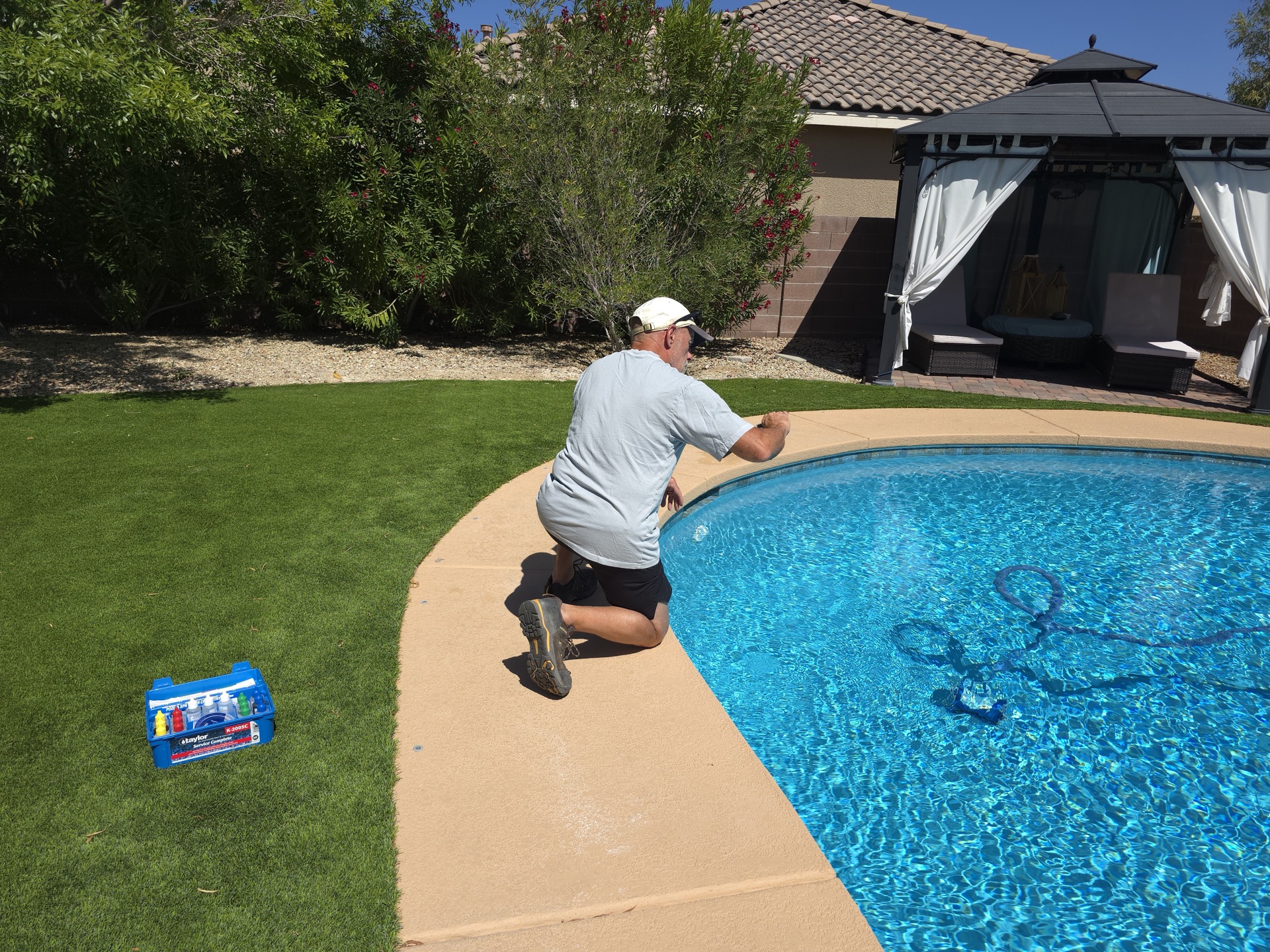
The K-2006 tests six things: free chlorine, combined chlorine, pH, total alkalinity, calcium hardness, and cyanuric acid (the stabilizer that protects chlorine from burning off in sunlight).
For a plain-English explanation of what each of those parameters means and how they interact in Las Vegas pool water, see our pool chemistry guide.
That combined chlorine number is the one strips almost always miss, and it is one of the most useful readings in pool chemistry.
What Is Combined Chlorine and Why Does It Matter?
Here is the version that makes sense without a chemistry degree.
Chlorine does its job by attacking bacteria, algae, and other contaminants in the water. Once it has done that work, it becomes chemically “spent.” It is still in your water. It will still show up on a chlorine test. But it can no longer sanitize anything.
That spent chlorine is called combined chlorine, or chloramines. And it is actually the thing responsible for the sharp pool smell and the eye irritation people associate with too much chlorine. A pool that smells strongly like a public pool or burns your eyes is not over-chlorinated. It has too many chloramines, which is a different problem with a different fix.
Test strips typically cannot separate free chlorine (the active kind) from combined chlorine (the spent kind). If your strip shows three parts per million, it may be showing you a mix of both. The drop test tells you exactly how much is free and how much is combined. That distinction changes what the pool actually needs.
Why Your Readings and the Pool Store’s Readings Do Not Match
This comes up often. A homeowner tests at home, everything looks fine. They bring a water sample to the pool store, and the numbers are different.
A few things cause this.
Strips degrade. A bottle that has been open for months in a hot garage is reading less accurately than the day it was new. The pads on each strip absorb moisture from the air over time, which changes how the color develops.
Color reading is personal. What one person reads as a three, another reads as a four. The pool store is likely using a calibrated liquid test or a digital meter, not a visual comparison.
Stabilizer readings are particularly unreliable on strips. Cyanuric acid is hard to read accurately with a color pad. Getting stabilizer wrong affects every other chemistry decision you make, because stabilizer is what determines how effectively your chlorine works in direct desert sunlight.
How I Use Both
I carry both tools to every service visit. They are not in competition with each other. They serve different jobs.
I will run a strip when I first arrive to get a quick read on the water. But before I adjust anything, I use the drop test. The strip tells me where to look. The drop test tells me what to do.
When something does not add up, a pool burning through chlorine faster than it should, or a customer saying the water does not feel right even though their strips look fine, the drop test is where the real answer usually shows up.
One situation I see regularly: strips are showing a chlorine reading, but the water is slightly hazy and the owner cannot figure out why. The drop test often shows that most of what the strip is reading is combined chlorine, not free chlorine. The pool is not under-treated. It needs a shock treatment to burn off the chloramine load and restore active sanitizer. Two completely different responses, and the strip alone cannot tell you which one you need.
What This Means If You Are Testing Your Own Pool
Test strips are not bad tools. They are good for catching something obviously wrong between professional visits. If you are maintaining your own pool, testing regularly with strips is better than not testing at all.
But if something is off and you cannot figure out why, a strip is probably not giving you enough information. A full water test at a pool store that uses calibrated equipment, or a professional visit with a drop test kit, will show you what is actually happening underneath the surface reading.
The goal is not to pick the right tool once and stick with it. It is to understand what each tool is actually telling you.