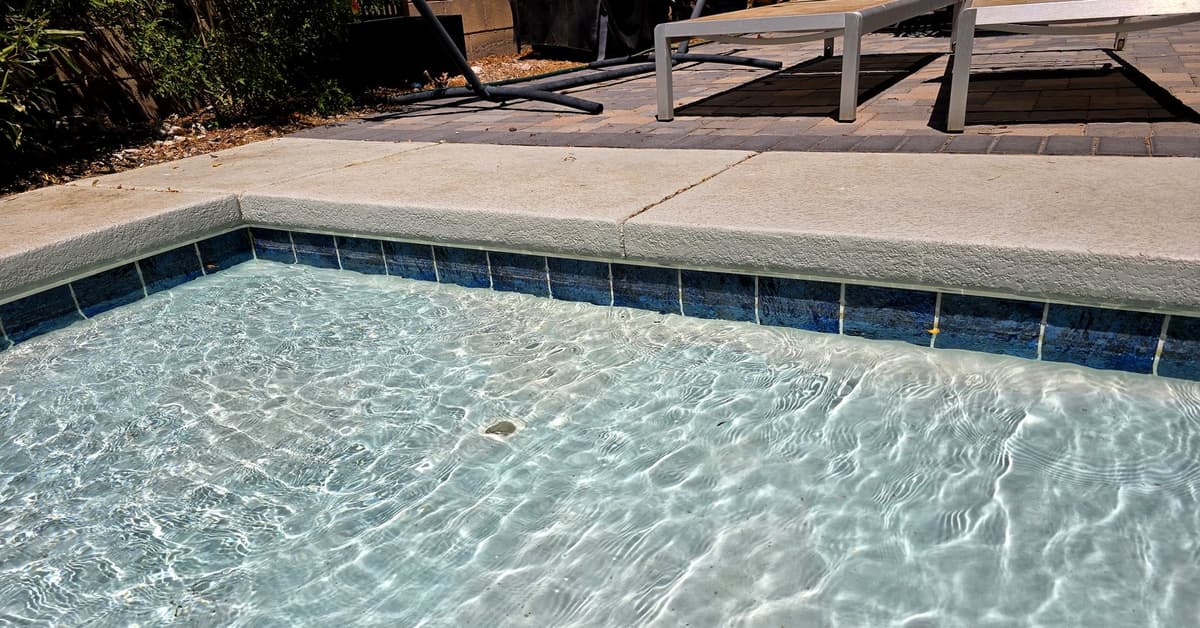
There is a white band around the tile at your waterline. It was not there when you moved in, and scrubbing does not take it off.
Or someone has looked at your pool, told you it needs to be drained, and the number attached to that made you wonder whether you were being sold something.
Those are the same problem, and neither one is a surprise. Both started the day the pool was filled, and you can see them coming years out if you know the two numbers involved.
The Two Numbers
The first is on the back page of the Las Vegas Valley Water District’s 2026 Water Quality Report, next to a note about setting your water softener. Our water hardness is 280 parts per million, or 16 grains per gallon.
That is hard water. About 90% of it is Lake Mead, which is Colorado River water carrying calcium and magnesium it picked up coming down from the Rockies. For drinking, this is a non-issue, and the report is direct about it: those minerals pose no health risk. The District ran more than 328,000 analyses on over 67,000 samples last year, and the water meets or surpasses every Safe Drinking Water Act standard.
Your pool is a different situation, for one reason. Your pool does not drink the water. It evaporates it.
Sun is the part everyone thinks of, and it does the least interesting work. Our humidity sits in the single digits for months, and dry air pulls water off a pool far harder than the same heat would somewhere humid. Wind strips off the damp layer sitting right on the surface and replaces it with more dry air, which starts the whole thing over. Then summer air temperature does its part on top. Four forces, all pushing the same direction, most of the year.
The second number comes from the Southern Nevada Water Authority: an uncovered in-ground pool loses 48.6 gallons per square foot per year to evaporation. A typical Southern Nevada pool runs around 470 square feet.
That is roughly 22,800 gallons a year off an ordinary backyard pool.
Water Evaporates. Calcium Does Not.
Put those together and the white line on your tile stops being mysterious.
Twenty-two thousand gallons leave your pool as vapor. The water goes. Every grain of calcium those gallons carried stays behind, in a slightly smaller volume of water than before. Then you top off, and 16 grains per gallon of fresh calcium comes in through the hose to join what is already there.
Nobody added anything. Nobody made a mistake. The concentration climbs because of the reasons mentioned above, and it does it every summer whether anyone is watching or not.
Eventually the water cannot hold any more, and the calcium leaves solution and lands on the nearest surface. That is your tile line. It is also the sandpaper patch on the plaster, the salt cell that stopped producing properly, and the heater quietly losing efficiency as its exchanger scales.
So when someone tells you your pool needs a drain, that is usually not a pitch. Once calcium hardness and total dissolved solids climb past what chemistry can manage, dilution is the only lever left, and dilution means new water.
Your Spa Is Doing This Faster
Here is the part that gets missed in July.
Almost nobody in the Las Vegas Valley heats their pool in the summer. Ambient heat does that for free. If someone tells you to turn your pool heater down this month to save water, they are reciting a pamphlet instead of looking at your yard.
The spa is a different story. Spas run hot year round, hold a fraction of the water, and carry far more surface area relative to volume. Heat drives evaporation, and a small hot body of water loses a much larger share of itself than a big warm one does. Per gallon, your spa concentrates hardness faster than your pool, and it does it in all 12 months instead of 5.
If you have a spa on the same system and you actually use it, that is where scale shows up first. Look at yours before you go looking at the pool.
About Covers
The math on covers is real. SNWA puts the evaporation reduction at about 90%, and industry figures run as high as 97%. On a 470 square foot pool, even the conservative number is the difference between losing 22,800 gallons a year and losing something near 2,300. Twenty thousand fewer gallons of hard water through the hose means calcium climbs far more slowly, which pushes your eventual drain years out.
I am still not going to tell you to buy one.
In July, a cover you handle by hand comes off in the morning and does not go back on, and a cover that does not go back on saves nothing. The math assumes a behavior that mostly does not happen. An automatic system solves that, and an automatic system is a real expense that has to earn its keep against a water bill and a drain you may be years away from.
That is the honest version: the savings are genuine and conditional, and whether the condition is worth meeting depends on your setup and your budget rather than on a number in an article. It is a reasonable thing to consider and a bad thing to feel guilty about.
Here is what I would spend your attention on instead.
Where the Water Actually Goes
Ranked, in the order I would check them.
1. Your autofill. The symptom here is the absence of a symptom. An autofill valve that has started passing water holds your pool at a perfect level all summer while quietly running your meter. Nobody notices, because the pool looks right. I have not had a client turn out to have one, which is not the reassurance it sounds like: a bad autofill hides, and nothing about a pool that looks correct would bring it to my attention. It goes first on this list because it is the only one you cannot catch by looking. Shut the water off to it and see whether the level holds.
2. Leaks. Watching your water line in July tells you nothing, because evaporation moves the line on its own. The bucket test separates the two. Turn off your autofill and your pump for 24 hours. Place a 5 gallon bucket with a brick in it on the first or second step of your pool. Fill the bucket with water to the exact level of your pool water. With a permanent marker or water proof tape, mark the water levels on both the outside and inside of the bucket. Check back in 24 hours. If the pool water has gone down more than the bucket water, your pool has a leak. SNWA’s rebate programs include a leak detection voucher toward diagnostic work, worth reading before you pay out of pocket to chase one down.
3. Your filter. If you have a sand filter and a working psi gauge, clean a cartridge when operating pressure climbs about 10 psi over its clean baseline, not on a date you picked in advance. Backwashing a sand filter on a guessed schedule sends clean water to the sewer for nothing.
Balanced water belongs on this list too, for a reason people do not expect. Corrosive water works on your plumbing over years and creates the leaks you then have to go find. Keeping water balanced is leak prevention on a long enough horizon.
The Rules Here Already Moved
AQUA Magazine’s Government Relations Advisory Committee published a piece this month called The Imperative to Save Water. It is written for builders and commercial operators, and the argument is that more than 40 states expect shortages within a decade, pools are turning into visible regulatory targets, and the industry should cut water use before regulators do it for them.
Reading it from here is strange because it describes this as a coming threat. This already happened to us in the Las Vegas Valley.
Since September 1, 2022, new single-family residential pools in the Water District’s service area are capped at 600 square feet of surface area, specifically because of evaporative loss. Pool water has to go to the sanitary sewer to be recycled, at a recommended maximum of 12 gallons per minute, and never to a septic system. There is a written industry standard for it now, PHTA-13, currently being revised around drought.
That is a water authority doing the math on a river that supplies 90% of the valley. The practical takeaway is smaller than the headlines: the habits other markets are about to be pushed into are already just good sense here.
What I Do About It
I test calcium hardness every 6 weeks and log it, so the trend shows up months before it becomes a drain. I watch the saturation index and balance the water against the calcium it already carries, which keeps that calcium in solution and off your tile. I clean filters on pressure. And I pay attention to how much water a pool asks for, because a pool that suddenly wants more is telling me something.
You cannot stop the concentration. It arrives with the fill water and it is not going anywhere. What you can control is the pace, and whether you know your timeline or get surprised by it.
Draining is not unique to Las Vegas. Every pool, everywhere, should get at least partly drained and refilled on a regular basis, because the dissolved minerals climb until fresh water is the only way to bring them back down. What Las Vegas changes is the pace: our fill water starts harder and our summers concentrate it faster, so that cycle comes around sooner here than it does in a wetter city with softer water. It should be considered regular maintenance. In Las Vegas I recommend going no more than 2 years. That said, there is no hard and fast rule, the numbers will tell you: high TDS, calcium hardness and/or CYA demands at least a partial drain and refill. That could happen after 3 years, it could happen after 1 year.
If the buildup is already on your tile, taking it off is a separate job with real tradeoffs, and I will cover that in its own post shortly. For the related question of when a drain is actually the right call, and why summer is the wrong time for one, see When to Drain a Las Vegas Pool: Not in Summer.