This is the question I get more than any other, and it usually arrives with the same details attached. The pool looked fine last week, nobody changed anything, and now the water has gone the color of skim milk.
Cloudy water is stubborn because it is really four separate problems that happen to look identical from the deck: chemistry that has drifted, a filter that is not keeping up, water that is not moving enough, and something that got in from outside. Each one wants a different fix. Most people skip straight past that and reach for a clarifier or a bag of shock, wait 2 days, and end up with a pool no clearer than when they started.
Work out which one you have before anything goes in the water.
- Milky white or gray haze, and your pH tested high. Your water balance is off. Calcium is dropping out of the water, and your chlorine is working at a fraction of its strength.
- Dull and hazy all over, and the filter pressure has crept up. Your filter is not catching what it should, or it is dirty enough to be passing it straight through.
- Worse by evening, clearer by morning. The water is not moving enough. Your pump is not running long enough to get the whole pool through the filter.
- It showed up after a busy weekend, a windy week, or in spring. Something got in. Swimmers, dust, or pollen.
1. Your pH Is High and Your Chlorine Is Low
I see this combination more often than any other, and it is the single most common answer to the question: pH high, free chlorine low, water cloudy. Two things go wrong at once, and they feed each other.
The first is that your pH decides how hard your chlorine is able to work. Chlorine sits in the water in two forms, and only one of them, hypochlorous acid, does the actual killing. At a pH of 7.5, about half of your chlorine is in that useful form. At a pH of 8.0, it is down to roughly a quarter. Your test kit still reads 3 ppm either way, so on paper the pool looks fine, while in practice most of the chlorine you paid for is sitting there doing very little.
The second is calcium. Our tap water is hard to begin with, and as pH climbs, the calcium in it stops staying dissolved and turns into a fine white powder suspended through the water. None of that is algae or dirt. It is the water itself letting go of minerals, which is why this kind of cloudiness looks white or gray rather than green. If you want the longer version of why Las Vegas Valley water behaves this way, I wrote about it in Why Las Vegas Pools Build Up Calcium.
The fix is an order of operations, and the order is the part people get wrong. Bring pH down first, into the 7.4 to 7.6 range. Then deal with chlorine. Chlorine added to a pool sitting at pH 8.0 is partly wasted the moment it hits the water, so correcting the pH first means the chlorine you add actually does something. Add acid with the pump running, spread it around the perimeter rather than dumping it in one spot, and give it an hour before you retest.
On the pools I service I aim lower than that, right around 7.3. Anything from 7.2 to 7.8 is acceptable water, but pH here does not sit still. Our fill water is hard to begin with, summer evaporation concentrates it further, and any water feature that aerates the pool drives pH up on its own. Starting at 7.3 gives the pool room to drift up into range between my visits instead of drifting out of it. If you test your own water weekly, that same logic is worth borrowing.
2. Your Filter Is Not Catching It
Cloudy water is really just water carrying particles too small to see one at a time, and pulling those out is the filter’s entire job. So when a pool stays cloudy, the filter is either too coarse to catch what is floating in there, or it has stopped doing the job properly.
Every filter has a size limit, measured in microns. Sand catches down to about 20 to 40 microns, a cartridge filter is finer at roughly 10 to 15, and DE is the finest at 2 to 5. For scale, a human hair is around 70 microns across. Anything smaller than your filter’s limit sails straight through, comes back out the returns, and goes around again as many times as you like.
That is the filter working as designed, though, and it is the less common problem. More often the filter has stopped living up to its own rating: a cartridge with a split in it, a sand filter where the water has worn a channel and now runs around the sand instead of through it, or one that is simply overdue for a cleaning. And here is the part that surprises people. Rising pressure on the filter gauge does not mean the filter is working harder. It means less water is getting through it. A gauge sitting 8 to 10 psi above where it reads clean is telling you the flow is being strangled, not that the water is getting cleaner.
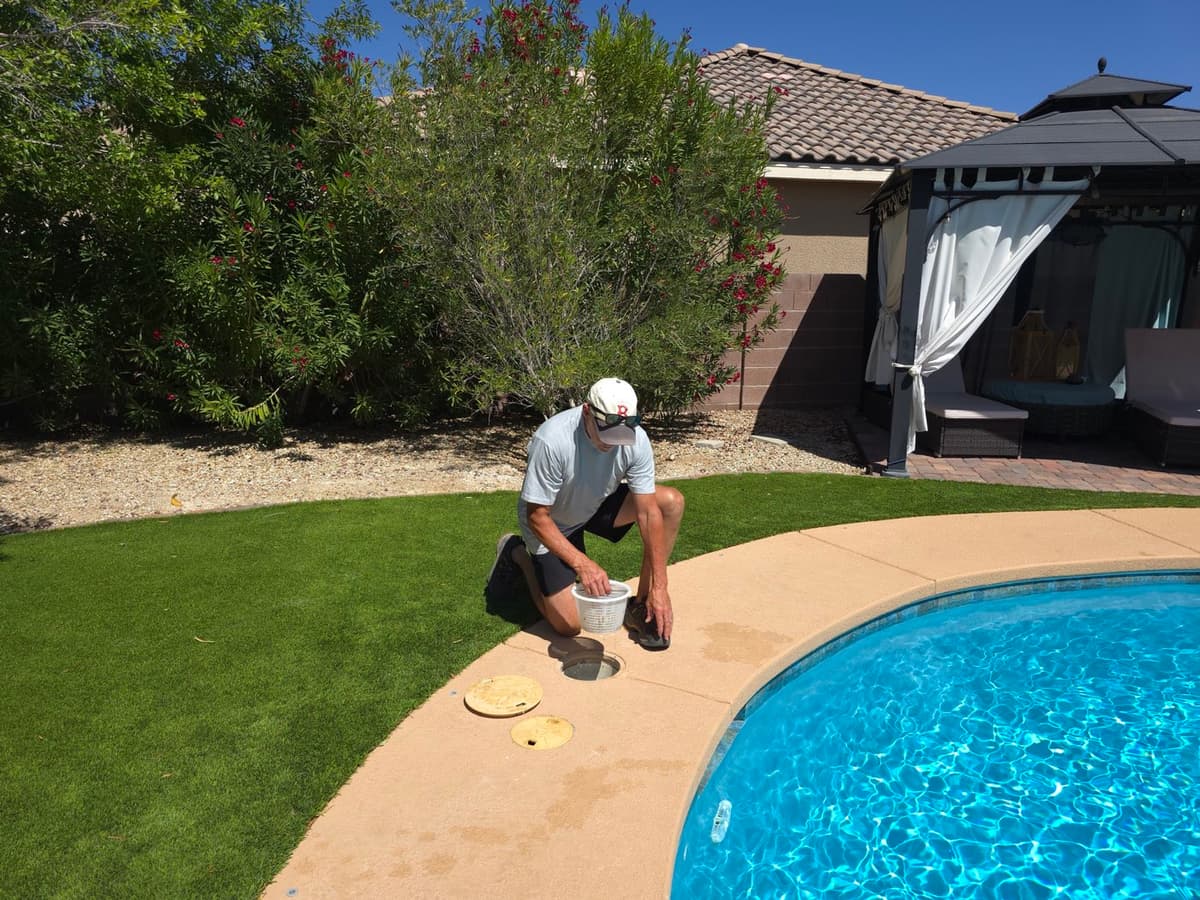
The baskets come first. A full skimmer basket chokes the flow before the water ever reaches the filter.
Dust is the local complication. Clark County issues dust advisories through the year, and fine desert dust is exactly the kind of small, hard particle that loads a filter fast and slips through a coarse one. If you run a sand filter in this valley, you are backwashing more often than the manual assumes. On cartridge systems I work to a 3 to 4 month cleaning interval, and a pool under heavy dust or heavy use needs it sooner. There is more on how the three filter types compare in the pool system guide.
3. The Water Is Not Moving Enough
A filter can only clean the water that reaches it. If your pump is not running long enough, most of your pool never goes through it.
The measure that matters is turnover: one turnover means your entire pool volume has passed through the filter once. In summer here, I want the water turning over a couple of times a day, which for most Las Vegas Valley pools means running the pump 10 to 12 hours. That is longer than the generic advice you will find, and it is deliberate. Our heat, our sun, and our dust all ask more of the system than a pool in a mild climate ever has to give.
Runtime is the first thing people cut, because the pump is what shows up on the power bill. Then the water goes cloudy in July, and the shock they add does not fix it, because that shock is sitting in a pool the water is barely moving through. When the cloudiness came off swimmers or plants, which is what most summer cloudiness is, a clean filter and enough run time is the whole fix. Nothing else needs to go in the water. I go into run time in detail in How Long Should Your Pool Pump Run in Las Vegas. There is also a quick way to see where your own water is not moving: shut the pump off for 20 minutes and look at what settles out, which I cover in Your Pool Looks Clean. Turn the Pump Off..
4. Something Got Into the Water
Three sources account for most of it here. They are not equal, and swimmers are the biggest by a distance.
People. Everyone who gets in brings sunscreen, body oil, and sweat with them. Your chlorine has to break all of it down, and it does not break down cleanly or quickly. What is left stays suspended as a fine haze, and it collects at the waterline as that grayish ring. A heavy swimmer load produces the cloudiest water I see all year, well past what pollen or dust manages. This is the pool that is clear on Friday and cloudy on Monday after a busy weekend. If that is a regular pattern at your house, Is Your Pool Part of Your Party Plan? covers how to get ahead of it.
Pollen, from late winter through spring. Most pollen is fine enough to pass straight through a sand filter, so it keeps going around instead of coming out. That is why a pool can hold a haze for weeks in the spring while its owner keeps adjusting chemistry that was never the problem.
Dust, after wind. A windy stretch puts a load of fine grit into an open pool in a few hours. I wrote about what a windstorm actually does to a pool in What a Las Vegas Windstorm Does to Your Pool.
Do You Actually Need a Clarifier?
Often, no. It is the first thing most people buy and close to the last thing they need.
A clarifier does not take anything out of your pool. What it does is gather the smallest particles into clumps big enough for your filter to catch, and then the filter does the removing. That difference matters, because it means a clarifier is only ever as good as the filter behind it. Pour one into a clogged filter on a pump running 4 hours a day and you have wasted the bottle.
So if the cloudiness came off people, plants, or algae, fix the chemistry, clean the filter, and run the pump. That clears it. A clarifier earns its place with the other kind of cloudiness: fine dust and mineral particles, the sort a windstorm leaves behind, which chlorine cannot break down no matter how much of it you add. Clumping those together really is the fastest way to clear the water. Give it a full 24 hours to work.
Flocculant is a different product, and the two are not interchangeable. It sinks everything to the floor of the pool, and then you vacuum it out through the waste line with the pump off, so none of it passes through your filter. That is more work, it costs you water, and if you have a cartridge filter you cannot do it at all, because those systems have nowhere to send the dirty water. Worth knowing before you buy the wrong bottle.
I have never had to use one myself. That is not a knock on the product, just a measure of how rarely it comes to that when the chemistry and the filter are both being kept up.
- Test first. pH and free chlorine, before anything goes in.
- Correct pH into the 7.4 to 7.6 range. Nothing else works properly until this is right.
- Bring free chlorine back into range. Now it will actually do what you paid for.
- Clean the filter. Not “check the pressure.” Clean it.
- Run the pump long enough for at least two full turnovers. 10 to 12 hours in summer.
- Give it 24 hours before you add anything else. Most pools clear right here.
- Only then consider a clarifier, and only if what is left is a fine dust or mineral haze.
One Thing Worth Watching
If your water stays cloudy while your free chlorine keeps dropping faster than it should, that is a different signal. Cloudiness with a chlorine level you cannot hold could be an early sign of an algae bloom rather than a filtration problem, and it wants a different response. I covered what that actually takes in Why Pool Algae Keeps Coming Back in Las Vegas.
Cloudy water is fixable, and in most cases you can fix it without buying anything at all. You just have to match the fix to the cause, and go in that order.